For informational purposes only. Not investment advice.
Our Investment Strategies
Our strategies are designed to adapt to changing markets and reduce the impact of major drawdowns. Rather than relying on static allocations, we combine multiple approaches to create a more resilient portfolio structure.
Blended Strategy (Flagship Approach)
Designed to reduce drawdowns and adapt to changing market conditions.
This framework integrates adaptive multi-asset allocation with equity momentum to create a diversified, risk-aware portfolio.
Download Framework PDF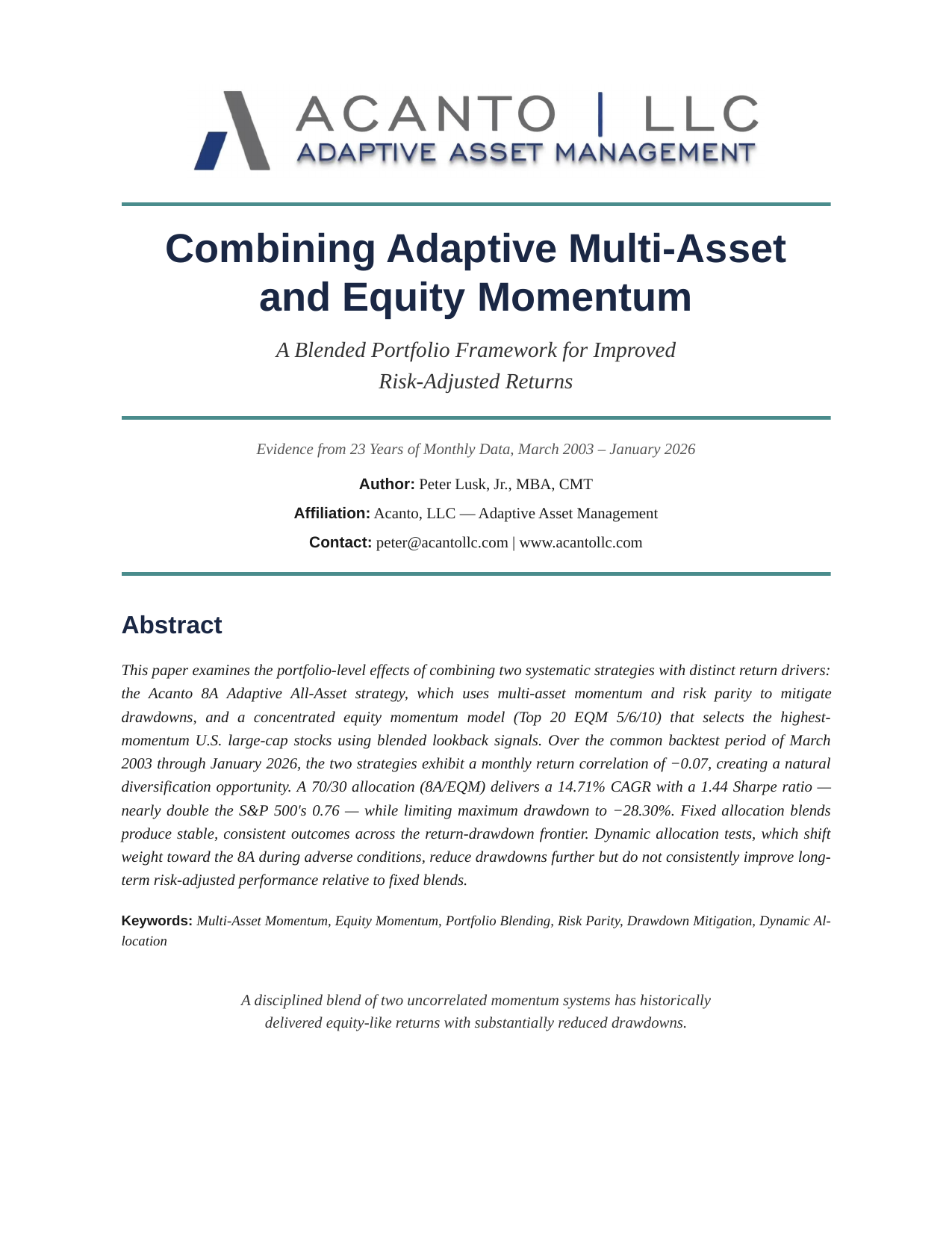
Understanding Risk and Drawdowns
Most portfolios—even diversified ones like 60/40 and similar allocations—are designed to grow, not survive.
In 2000, 2008, and again in 2022, investors experienced losses that took years to recover from. The issue is not volatility — it is the depth and duration of drawdowns.
A 40–50% loss requires a 70–100% gain just to break even.
For investors taking withdrawals, losses are even more damaging—because recovery requires both market gains and time that may not be available.
That changes behavior. It changes retirement outcomes.
Why Traditional Diversification Fails
Most traditional diversified portfolios—including 60/40 and similar allocations—assume that stocks and bonds will offset each other.
In 2022, both declined at the same time.
For many investors, this was the first real experience of correlated losses across asset classes.
A Different Approach
Instead of relying on static diversification, a more adaptive approach:
- Adjusts exposure based on current market behavior
- Allocates across multiple asset classes
- Focuses on limiting drawdowns rather than maximizing returns
This approach does not attempt to predict markets.
It responds to them.
What This Means
A rules-based framework can shift:
- Away from risk assets during periods of deterioration
- Toward alternative assets when trends change
- Back into growth assets when conditions improve
The goal is not perfection. It is avoiding the kind of losses that change financial outcomes.
Core Investment Strategies
Deep dives into the specific methodologies that power our adaptive approach.

Adaptive All Asset Strategy (8A)
This foundational paper explores the predictive power of coincidental indicators in financial markets. It challenges traditional forecasting methods and proposes a more robust framework for understanding market dynamics, forming the bedrock of Acanto's data-driven approach.

Equity Momentum Strategy
A deep dive into the mechanics of equity momentum. This paper unpacks how systematic, rules-based approaches can identify and capitalize on persistent trends in the stock market, providing a powerful tool for growth-oriented allocations.
Ready to gain clarity?
Start with a 30-minute introductory call
This content is for informational and educational purposes only and does not constitute investment advice, a recommendation, or an offer or solicitation to buy or sell any securities or investment strategies.
Any references to investment strategies, asset allocations, or market positioning are general in nature and may not be suitable for all investors. Investment decisions should be made based on an individual’s specific financial situation, objectives, and risk tolerance.
Certain materials may include hypothetical, backtested, or model performance results. These results are for illustrative purposes only, are based on assumptions, and do not reflect actual trading. Hypothetical performance has inherent limitations and does not represent actual client experience.
Where performance is shown, it may be presented on a gross-of-fees basis and does not reflect the impact of advisory fees, transaction costs, or taxes, which would reduce returns.
Strategies, models, and allocations are subject to change at any time without notice. Not all client accounts will hold identical positions or experience the same results.
Past performance is not indicative of future results. All investments involve risk, including the possible loss of principal.